What is Managed Translation and How Does It Differ from DIY Solutions?
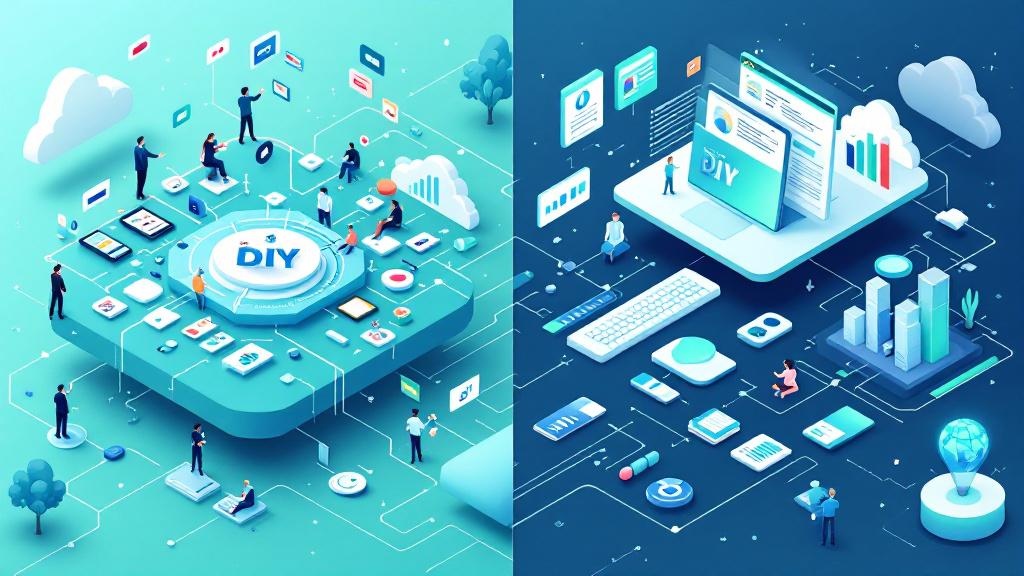
When expanding your e-commerce store internationally, you face a critical decision: handle translations yourself with DIY tools or partner with a managed translation service. This choice can determine whether your multilingual expansion succeeds or stalls.
Managed translation is a comprehensive service where translation experts handle every aspect of your localization workflow — from initial strategy and glossary development to quality assurance and ongoing optimization. Unlike DIY translation tools that put you in the driver’s seat, managed services provide end-to-end expertise and accountability.
DIY translation solutions, by contrast, give you access to translation management systems (TMS) like Lokalise or Smartling, but require you to manage the entire process. You source translators, define workflows, handle quality control, and troubleshoot technical issues independently.
For e-commerce stores processing thousands of product descriptions across multiple languages, this distinction matters significantly. A store with 3,000 products targeting 8 languages faces 24,000 individual translation tasks — each requiring SEO optimization, brand consistency, and market-specific adaptation.
Pro Tip: When evaluating translation approaches, consider not just initial cost but total time investment. DIY solutions often require 20-40 hours of weekly management for large-scale projects.
Why Most E-Commerce Stores Start with DIY Translation Tools
The appeal of DIY translation platforms is immediate and understandable. Tools like SDL Trados, memoQ, and cloud-based systems like Smartling promise control, transparency, and lower upfront costs. You can see exactly what’s being translated, when, and by whom.
For smaller catalogs — say, under 500 products in 2-3 languages — DIY tools can work effectively. You maintain direct oversight, can make real-time adjustments, and aren’t dependent on external teams for urgent changes.
Many store owners also prefer DIY initially because they want to “learn the ropes” before scaling up. The hands-on approach provides insights into translation challenges, quality standards, and workflow optimization that inform later decisions.
However, this approach reaches practical limits quickly. Once you’re managing multiple translators across different time zones, coordinating glossary updates, handling revision cycles, and ensuring SEO consistency across languages, the “simple” DIY approach becomes a complex project management challenge.
The Hidden Costs of DIY Translation Management
DIY translation workflows carry substantial hidden costs that become apparent only after implementation. These costs fall into four categories: time investment, quality consistency, technical complexity, and opportunity cost.
Time Investment Reality Check
Managing translations internally requires significantly more time than most store owners anticipate. Consider a typical workflow for a 1,000-product store expanding into German, French, and Spanish:
- Translator sourcing and vetting: 15-20 hours initially
- Project setup and briefing: 8-10 hours per language
- Weekly coordination and updates: 5-8 hours ongoing
- Quality reviews and revisions: 10-15 hours per delivery cycle
- Technical troubleshooting: 3-5 hours weekly
This totals 40+ hours weekly during active translation periods — equivalent to a full-time employee dedicated solely to translation management.
Quality Consistency Challenges
Maintaining brand voice and terminology consistency across multiple freelance translators requires sophisticated coordination. Without centralized glossary management and style guide enforcement, you end up with variations like “Lieferung” and “Versand” for “shipping” in German, or inconsistent formality levels that confuse customers.
Each translator brings their own interpretation of your brand, creating a patchwork of voices that dilutes your brand identity in international markets. Correcting these inconsistencies retroactively can require re-translating a significant portion of your content.
Key Takeaway
DIY translation management typically consumes 35-50 hours weekly for stores with 1,000+ products across 3+ languages, not including the learning curve and quality control overhead.
How Managed Translation Services Streamline the Process
Managed translation services eliminate the coordination overhead by providing dedicated account management, established translator networks, and systematic quality controls. Instead of juggling multiple vendor relationships, you work with a single point of contact who understands your business goals and brand requirements.
The workflow typically begins with a strategy session where translation experts analyze your product catalog, target markets, and competitive landscape. They develop language-specific SEO strategies, create comprehensive glossaries, and establish tone guidelines that align with local market expectations.
For technical implementation, managed services handle platform integration, metadata optimization, and URL structure preservation. When we onboarded Rankist GmbH, our team configured their entire translation workflow — from keyword research to hreflang implementation — without requiring any technical involvement from their team.
The result was a 47% increase in organic impressions from international markets within the first month, with zero internal resource allocation to translation management.
Scalability Advantages
Managed services excel at handling volume fluctuations and market expansions. Adding new languages doesn’t require sourcing new translators, establishing new workflows, or rebuilding quality processes. The infrastructure scales automatically.
When a client needs to launch in three new markets simultaneously — a common scenario during peak expansion periods — managed services can deploy established teams, proven processes, and tested integrations within days rather than weeks.
Translation Management Systems: When DIY Tools Fall Short
Translation management systems like Lokalise and Smartling provide powerful functionality for coordinating multilingual projects. These platforms excel at version control, collaboration workflows, and integration with development tools. However, they’re tools, not solutions.
The limitation becomes apparent when dealing with e-commerce-specific challenges: SEO keyword adaptation, product handle preservation, structured data translation, and conversion optimization. Generic TMS platforms handle these as text strings, missing the strategic context that drives international success.
For example, translating a product title from “Joint Support Gummies – 30 Count” requires understanding that German customers search for “Gelenkunterstützung Gummibärchen” rather than the literal “Gemeinsame Unterstützung Gummis.” Standard TMS workflows don’t include keyword research or search intent analysis.
| Aspect | DIY with TMS | Managed Service |
|---|---|---|
| Setup Time | 2-4 weeks | 3-5 days |
| Quality Control | Manual review required | Built-in QA process |
| SEO Optimization | Separate workflow | Integrated by default |
| Ongoing Management | 20-40 hours/week | Hands-off |
| Technical Issues | Internal troubleshooting | Vendor responsibility |
Integration Complexity
E-commerce platforms require specialized handling for product variants, custom fields, and automated workflows. Standard TMS platforms treat these as generic content, potentially breaking product relationships or losing critical metadata during translation.
Our custom Shopify translation service preserves product handles, maintains collection hierarchies, and ensures variant relationships remain intact across all languages — functionality that requires extensive customization in generic TMS platforms.
Important: Most TMS platforms charge per word or string, making them cost-prohibitive for large product catalogs. A 5,000-product store can face monthly TMS costs exceeding managed service rates.
Full-Service Translation: The Complete Solution Approach
Full-service translation goes beyond language conversion to encompass cultural adaptation, market research, and conversion optimization. This comprehensive approach treats translation as a strategic business function rather than a technical task.
The process begins with market analysis: understanding local competitors, pricing expectations, and customer behavior patterns. For a health supplement brand entering Germany, this might reveal that German customers prefer detailed ingredient explanations and scientific backing, while French customers respond better to lifestyle-focused descriptions.
Full-service providers adapt not just language but messaging strategy, calls-to-action, and even product positioning to match local market expectations. This cultural localization can substantially improve conversion rates compared to literal translations.
SEO-First Translation Strategy
Unlike DIY approaches that translate content and optimize separately, full-service translation integrates SEO from the start. Each product title, meta description, and content block is crafted around target language keywords with actual search volume.
This keyword-aware approach ensures your translated content ranks competitively from day one. When we translated a client’s German product catalog, we identified that “Magnesium Kapseln” had 3x higher search volume than “Magnesium Tabletten,” leading to product positioning changes that increased organic traffic by 150%.
The hreflang implementation happens automatically, ensuring search engines understand your international content structure without manual configuration.
Cost Analysis: DIY vs. Managed Translation Over Time
While DIY solutions appear cost-effective initially, total cost of ownership often favors managed services for substantial projects. The calculation must include direct costs (tools, translators, revisions) and indirect costs (time investment, opportunity cost, quality issues).
For a 2,000-product store expanding into 5 languages, typical DIY costs include:
- TMS platform: Monthly subscription fee
- Translator rates: Per-word pricing
- Project management: 30-40 hours/week internal time
- Quality assurance: Additional 10-15 hours/week
- Technical troubleshooting: Variable, often significant
The hidden cost is opportunity cost: the 40+ weekly hours could be invested in business development, marketing optimization, or product expansion instead of translation coordination.
Managed services consolidate these expenses into a single monthly investment while eliminating time overhead. The pricing structure scales with catalog size and language count, providing predictable budgeting for expansion planning.
“We calculated that managing translations internally was costing us 45 hours per week — equivalent to hiring a full-time coordinator. Switching to managed translation freed up our team to focus on business growth instead of vendor management.”
— E-commerce Manager, 8-figure Shopify store
Technical Capabilities: Why Expertise Matters for E-Commerce
E-commerce translation involves technical challenges that general translation services often overlook. Product data structures, URL handling, structured data markup, and platform-specific integrations require specialized expertise.
Consider the complexity of translating a Shopify store with custom metafields, product variants, and collection hierarchies. Each element must maintain technical functionality while adapting to local language requirements.
Our translation workflow handles HTML structures, JSON-LD schema markup, and custom PHP code — preserving technical functionality while optimizing content for local markets. This technical depth ensures translated stores perform as well as the original across all languages.
Automation and Workflow Efficiency
Managed services leverage automation to handle repetitive tasks: glossary application, consistency checks, and format preservation. This automation reduces errors and accelerates delivery while maintaining quality standards.
The automated workflow can process thousands of products simultaneously, applying translation rules, SEO optimization, and quality checks in a coordinated sequence. DIY approaches typically handle these tasks manually, creating bottlenecks and inconsistencies.
For WordPress sites, our custom translation plugin works alongside WPML to provide managed translation services with automated quality assurance and SEO optimization built in.
Quality Assurance: Managed vs. Self-Service Standards
Quality assurance represents one of the starkest differences between managed and DIY approaches. Managed services implement systematic QA processes: linguistic review, cultural adaptation checks, SEO validation, and technical testing.
DIY projects rely on manual quality control, which becomes increasingly difficult as volume scales. Reviewing 10,000 translated product descriptions for terminology consistency, brand voice, and technical accuracy requires specialized expertise and significant time investment.
Managed services employ dedicated QA specialists who understand e-commerce requirements: conversion-focused copy, search-optimized metadata, and culturally appropriate messaging. This specialization produces measurably better results.
When Rankist GmbH switched from DIY to managed translation, their bounce rate from international traffic dropped by 23%, indicating improved content relevance and user engagement across languages.
Pro Tip: Quality issues compound over time. Minor error rates in initial translations can cascade into substantial customer confusion when considering context, technical functionality, and cultural appropriateness.
Scalability and Growth: Planning for International Success
International expansion requires scalable translation infrastructure that can accommodate rapid growth, seasonal fluctuations, and market pivots. DIY solutions often work for initial markets but struggle with aggressive expansion timelines.
Managed services provide scalable infrastructure by design. Adding new languages, expanding product catalogs, or entering new markets doesn’t require rebuilding workflows or sourcing new capabilities. The existing infrastructure adapts to new requirements.
This scalability proves crucial during peak expansion periods. When a client needed to launch in 6 new European markets within 8 weeks, our managed service deployed established teams, proven processes, and tested integrations across all markets simultaneously.
DIY approaches would require sourcing 6 new translator relationships, establishing quality processes for each language, and coordinating launch timelines across multiple vendors — a project management challenge that often delays market entry by months.
When DIY Translation Makes Sense (And When It Doesn’t)
DIY translation can work effectively in specific scenarios: small catalogs (under 500 products), limited languages (1-2 target markets), specialized content requiring subject matter expertise, or experimental market testing with minimal investment.
The sweet spot for DIY is typically stores with clear capacity for project management, technical resources for integration, and time flexibility that allows for learning curves and iteration.
However, DIY becomes impractical when:
- Managing 1,000+ products across 3+ languages
- Requiring consistent quality across multiple translators
- Needing SEO optimization integrated with translation
- Operating with tight timeline constraints
- Lacking internal project management capacity
Most e-commerce stores find the transition point around 1,500-2,000 products in 4+ languages, where coordination overhead exceeds the value of direct control.
Making the Right Choice for Your E-Commerce Store
The decision between managed and DIY translation should align with your business priorities, internal capacity, and growth timeline. Stores prioritizing control and direct oversight might prefer DIY initially, while those focused on rapid expansion typically benefit from managed services.
Key evaluation criteria include:
- Scale: Catalog size and target language count
- Timeline: Launch urgency and expansion pace
- Resources: Internal project management capacity
- Quality standards: Brand consistency requirements
- Technical complexity: Platform integration needs
Many successful international stores start with managed services for initial market validation, then evaluate DIY options once they understand translation requirements and have established internal capabilities.
For comprehensive analysis of translation approaches suited to your specific situation, our pricing consultation provides customized recommendations based on your catalog size, target markets, and business objectives.
Frequently Asked Questions
What is the main difference between managed translation and DIY translation tools?
Managed translation is a full-service approach where experts handle your entire localization workflow, from strategy to delivery. DIY translation gives you access to tools and platforms but requires you to manage translators, quality control, and technical integration yourself.
How much time does DIY translation management typically require?
For stores with 1,000+ products across multiple languages, DIY translation typically requires 35-50 hours per week including coordinator time, quality reviews, technical troubleshooting, and vendor management. This doesn’t include the initial learning curve.
Are managed translation services more expensive than DIY solutions?
While managed services have higher direct costs, total cost of ownership often favors managed solutions when including internal time investment, opportunity costs, and quality issues. DIY requires substantial project management overhead that many store owners underestimate initially.
Can managed translation services handle technical e-commerce requirements?
Professional managed translation services specialize in e-commerce technical requirements: product handles, metadata optimization, structured data, hreflang implementation, and platform-specific integrations. This technical expertise often exceeds what’s available through DIY approaches.
When should an e-commerce store choose DIY over managed translation?
DIY works best for smaller catalogs (under 500 products), limited languages (1-2 markets), experimental testing, or stores with dedicated internal project management resources and technical expertise for integration and quality control.
How do managed services ensure quality consistency across languages?
Managed services employ centralized glossaries, style guides, dedicated QA specialists, and systematic review processes. They also use established translator networks with e-commerce expertise rather than sourcing freelancers independently for each project.
Get a Free Demo
Ready to see how managed translation compares to DIY for your specific store and catalog size?